


This week, the world’s climate chickens came home to roost. A new United Nations report outlined in clear terms what is now inevitable: that global warming will exceed 1.5 degrees, and under even best-case scenarios we’re on track for warming of at least 1.8 degrees.
Meanwhile, federal ministers delivered conflicting messages on Australia’s stance on climate, one calling for an accelerated transition away from fossil fuels, while another suggested that the lack of wars in the Asia-Pacific region was all thanks to Australian fossil fuel exports.
A warning to prepare for a global warming “overshoot”
This week, the United Nations Environment Program (UNEP) published a new report titled “Limiting Overshoot” which outlines in stark terms that the world is now set to blow past 1.5-degrees of global warming.
The UNEP warns this means there is a desperate need to scale up adaption measures in preparation for worsening climate impacts, planning now for how the world can remove accumulated excess emissions from the atmosphere to not just limit but actively lower global temperatures, and to further ramp-up and accelerate emissions reductions.
“Overshoot means [the 1.5-degree] goal must now be approached from above, while simultaneously adapting to the impacts of climate change. This means meeting and exceeding, not rescinding, existing commitments and concurrently delivering faster mitigation and adaptation,” the UNEP report says.
Almost anticipating an argument from fossil fuel interests that, now we are almost certain to exceed the 1.5-degree threshold, we should 'abandon net zero’, the UNEP reiterates the fact that there is no “safe” level of global warming and that every increment matters.
“Exceedance of 1.5°C should not be interpreted as safe or acceptable; there are no benign scenarios with global temperature rise above this level,” the UNEP report says.
“Every increment of warming avoided matters… every increment of warming not only increases harm, losses and damages caused by climate change, but that warming rises above 1.5°C also constrain some mitigation options.”
How did we get here?
When the world negotiated the Paris Agreement in 2016, we set ourselves an assignment: to reach net zero emissions in the second half of this century. This would give us a better than 50 per cent chance of limiting global warming to 1.5 degrees.
In 2016, that assignment was ambitious, but we had time.
It is now 2026, and we have spent the last decade largely procrastinating. Global emissions are higher than ever, and the 1.5 degree goal is effectively lost.
The UNEP’s report outlines a decade of inaction has created the current crisis:
“Emissions remain at record highs. In 2024 alone, fossil fuels and industry produced around 40 GtCO₂,” the report says. “At this rate, the remaining carbon budget for staying within 1.5°C would be exhausted in roughly three years. Put differently, to remain within this budget, global CO₂ emissions would need to decline linearly from 2025 levels to zero in just over six years.”
The 1.5 degree goal no longer means “net zero by the second half of this century”. It now means net zero by 2031.
To labour the metaphor, planning for overshoot, which as the UNEP has outlined is now absolutely necessary, is akin to blowing past a university assignment’s due date and deciding to cop the late submission penalty in the hope you can make up the lost marks.
One problem with this scenario is that we have limited means of making up for any overshoot. While the UNEP report calls for an increased focus on Carbon Dioxide Removal (CDR) to draw down the excess emissions that will need to be removed from the atmosphere so that the planet can eventually return to warming below 1.5-degrees, it does not represent a carte blanche call for prioritising carbon-capture and storage or the wide-scale conversion of land for carbon offsetting activities, over a rapid phase out of fossil fuels.
“Overall, even optimistic [carbon dioxide removal] scaling is unlikely to deliver a temperature reversal beyond a few tenths of a degree this century. This emphasizes the importance of focusing on reducing greenhouse gas emissions now,” the report warns.
In other words, carbon offsetting is not a pathway to achieving the emissions reductions needed to return the planet to 1.5 degrees of warming. Carbon removals will be necessary to remove excess emissions from the atmosphere - but the capacity is limited and so they cannot be used as a credit against additional emissions elsewhere.
Carbon removals may help us reduce warming from 1.8 degrees (the most ambitious scenario the UNEP considered feasible) back to 1.5 degrees - but not much more than that. So reducing greenhouse gas emissions must be the primary priority.
How has the Australian Government responded?
Despite the UNEP’s stark warning on global warming, the Australian Government continues to present a two-faced approach to climate change.
This was very much on show this week.
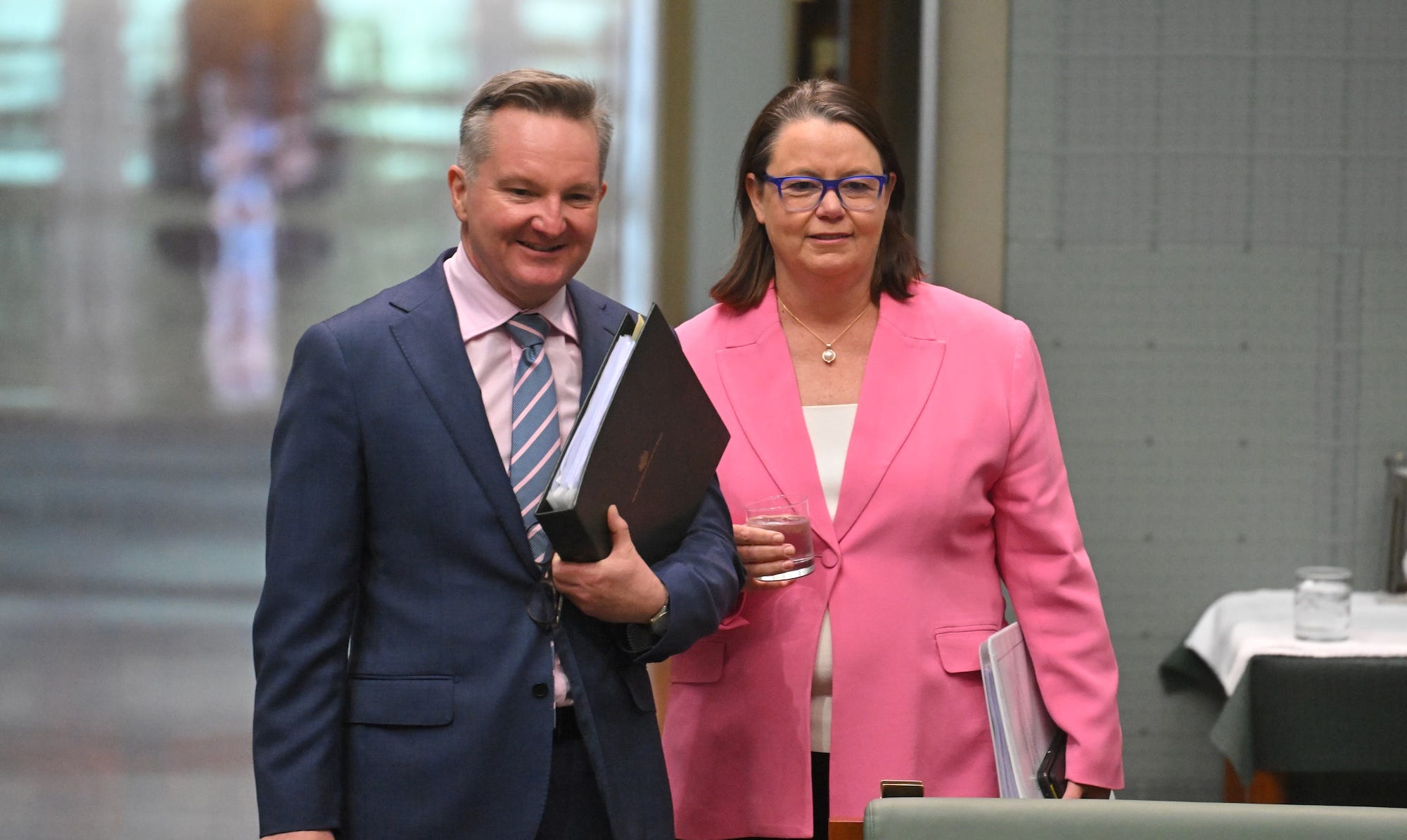
By virtue of his status as the “President of Negotiations” for COP31, federal climate minister Chris Bowen had a quote featured in UNEP’s own media release announcing the publication of the ‘Overshoot’ report, where he reflects a reasonable view that we must accelerate a transition away from fossil fuels.
“Every fraction of a degree of warming above 1.5 leads to increasing and increasingly severe climate impacts, with our Pacific family standing on the frontlines. While we know the challenge is growing, so too is momentum,” Bowen said.
“The recent energy crisis has reminded the world of the need to reduce our dependence on fossil fuels, accelerate the transition to renewable energy and bolster climate cooperation. COP31 is an opportunity to turn our ambition into action -- with Türkiye, Australia and the Pacific delivering a practical, solutions-focused COP.”
Representing the other side of the Albanese government’s two-faced approach to climate, federal resources minister Madeleine King was in the Northern Territory this week, literally turning the tap on for the first flows of fossil gas from the Beetaloo Basin.
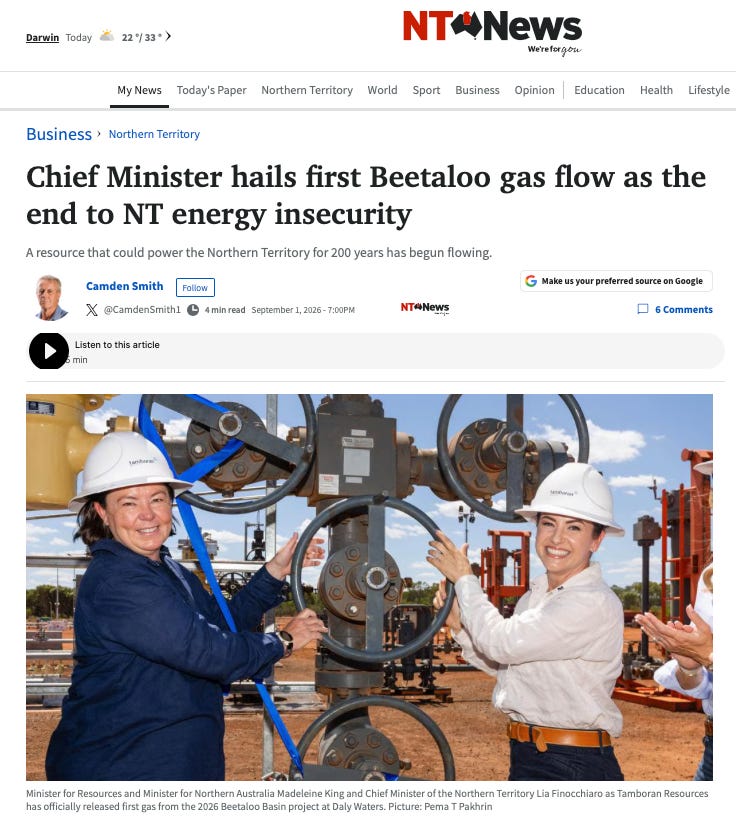
In a bizarre speech marking the first flows of fracked gas from the Beetaloo Basin, King appeared to attribute the lack of conflict in the Asia-Pacific region to Australian fossil fuel exports.
“Australia has benefited enormously from the development of a liquefied natural gas export industry through export revenue, royalties and taxation, job creation, and economic development,” King said.
“Indeed, our whole region and our trading partners has benefitted. As I have said repeatedly the sustained period of peace we have known in our region has been based on a steady and reliable supply of energy from Australia.”
The Beetaloo Basin has been described as a ‘carbon bomb’, with the potential lifetime greenhouse gas emissions from its gas expected to exceed 1.2 billion tonnes and likely economic benefits that are being grossly overstated by the NT government. There may be a lack of outright war in the Asia-Pacific region, but projects like those being developed in the Beetaloo Basin are still fuelling the existential climate threat posed to many low-lying Pacific island nations.
It’s also worth noting the Albanese government also granted approval for an extension to the open-cut Saraji mine in Queensland this week - which can now continue to extract coal until 2055.
As I write this piece, the Bureau of Meteorology has announced that the current El Niño event - the harbinger of hot, dry weather to Eastern Australia that fuels heatwaves, droughts and bushfires - has grown to record intensity.
Climate change is here, folks.
So very right to draw attention to the contradictions in this Labour Government on climate and indeed quite a few other policy areas. The falsely named Safeguard Mechanism for large industries is yet another example of allowing polluters to carry on emitting at scale and claim the fiction of carbon credit offsets. It’s a scam from start to finish. King is the fossil fuels industry best friend in my opinion. Most Australians are concerned about climate but so many remain in denial when it means affecting their “ lifestyle” A good 40% will vote for at the next election for Liberal , National or One Nation parties that want to dump net zero , even if our attempts are well short of what is needed. Far too many people are completely in denial but boy are they in for a reality check.
Bowen is pushing a substantially faster electrification in Australia than any government before. You may say that would not be hard: but it is hard; check his facebook for the constant attacks on anything he does.
Gas and coal mining and petrol extraction will last as long as there is a demand. You may prefer a simple fiat ‘there will not be’, a mechanism to see whoever does that ditched. Why do 3/4s of new car buyers still not go EV? A way to go to convince people to act as you think necessary. I understand that many think democracy does not matter in this context; a common thought about issues people think is all that matters.
As it is I face my state government being overturned because people are a bit tired of it and fussing about money being spent that actually produced new public transport. As a consequence the potential to not need coal power in this state will be pushed out - and with no coal power there is much less demand for coal mining so the mines will halt.