


This was originally published in RenewEconomy (subscribe to them, they’re great).
The fossil fuel industry playbook is so predictable, it is almost tedious. They continue to plan for ever-expanding oil, gas and coal production. They seek to win over governments by commissioning modelling that exaggerates the economic benefits new projects could deliver, all while ignoring the catastrophic harm fossil fuels will cause to the world’s climate systems and vulnerable communities.
The playbook was on show again last month, when fossil fuel giant Woodside announced that its proposed Browse to North West Shelf Project - a project that Woodside describes as “Australia’s biggest undeveloped offshore gas resource” - would generate more than $140 billion in economic benefits and billions in tax payments for Australia, and create thousands of new jobs.
Woodside’s figures are based on a report it commissioned from ‘big four’ consultancy Deloitte. That the ‘independent’ report was produced by the global consultancy firm lends its findings the veneer of credibility.
This is very much part of the service firms like Deloitte offer to their clients, particularly when those clients want to convince governments to approve new projects and with a final decision on environmental approvals for the Browse gas project expected in coming months, the clear audience for Deloitte’s report is government decision makers. Woodside is hoping that it can win support from the federal and Western Australian governments with the promise of billions in new investment, thousands of new jobs and a flood of new tax payments. Following the playbook.
Woodside’s release of the Deloitte report prompted Climate Integrity - a not-for-profit research organisation that works to increase science-alignment, transparency and accountability in corporate decarbonisation in Australia, and my employer - to dig deeper into Deloitte’s ‘economic impact assessment’ of Woodside’s Browse gas project.
To explain the extent of the problems with Deloitte’s analysis, it is useful to detail some of the flawed assumptions and analysis that have influenced its conclusions.
For example, Deloitte’s forecasts of the economic value of the Browse project - including increases to Australia’s GDP and the amount of tax it would pay to governments - are based on an assumption that gas prices will remain stable for the next 47 years. This is a bold assumption that not only defies broad market expectations, but is effectively predicated on a scenario where the world warms by as much as 3 degrees.
The Intergovernmental Panel on Climate Change (IPCC) and the International Energy Agency (IEA) have warned that demand for gas must decline by around 75 per cent by 2050 in order to limit global warming to 1.5 degrees. This is a massive decline in gas demand, which will lead to a collapse in global gas prices. The 2025 World Energy Outlookpublished by the IEA projects that, under a 1.5-degree of warming scenario, LNG prices in the Asian region will fall as much as 65 per cent by 2035 - falling below US$5/MMBtu and remaining at that deflated level until 2050.
Yet, Deloitte’s analysis assumes that gas prices will remain fixed at US$11.5/MMBtu until 2072, which contributes to inflated projections of the Browse project’s future economic benefits - inflating the revenues the project would receive and in turn inflating the resulting tax payments.
Woodside didn’t disclose that Deloitte’s assessment is effectively predicated on a future scenario where global warming is allowed to reach dangerous levels. A future where growth in fossil fuel production continues unchecked, and vulnerable communities are lumped with the costs of climate change fuelled disasters.
Woodside also didn’t say that in an average year, the project would be responsible for an additional 38 million tonnes of greenhouse gas emissions. This is equivalent to the entire annual emissions of Denmark. This might be due to the fact that Deloitte states that it did not “assess biodiversity, or cultural heritage impacts” or “model global climate outcomes”.
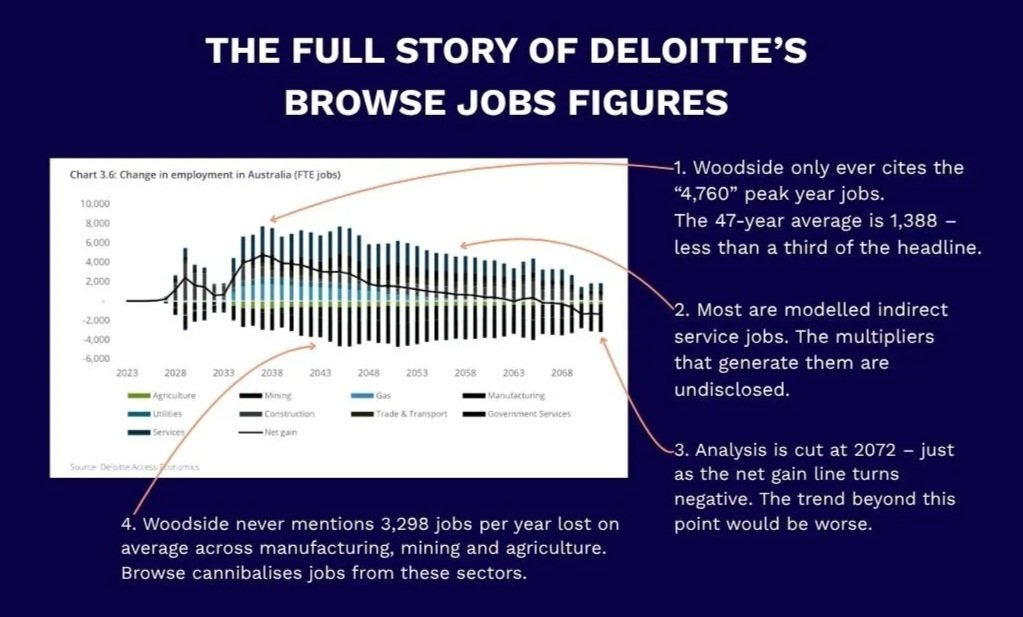
As another example, both Deloitte and Woodside cherry-picked the single year peak for jobs created by the project - 4,760 jobs in 2037. Both lead with this figure in their headline findings.
But digging into the details of Deloitte’s report shows that the average jobs created over the life of the project would be just 1,388. Employment declines considerably once construction has been completed and, concerningly, the Browse project would cannibalise jobs in the farming and manufacturing sectors, with jobs in these sectors declining by an average of 458 and 1,760, respectively.
This is an inconvenient message for Woodside - fossil fuel projects cannibalising jobs in farming and manufacturing - and so it’s no wonder these figures didn’t feature in the company’s media statement or in Deloitte’s headline findings.
One thing Deloitte didn’t shy away from stating was the expected impact of the Browse gas project on the renewables transition. In that case, Deloitte says the quiet part out loud, finding that “with the Project, additional gas supply allows parts of this transition to occur later”.
Building the Browse project will delay Australia’s transition to renewables.
On Woodside’s part, its commissioning of a biased report isn’t terribly surprising. Fossil fuel companies talk up the benefits of their projects all of the time, they promise governments riches - in terms of job creation and increased tax revenues - and gloss over the negative impacts.
Deloitte’s complicity in producing the report is more disappointing. This is a major global consultancy that holds itself out as a source of expertise and professional advice. It also presents itself as a global leader in climate action.
Deloitte Australia has set itself emissions reduction targets it says are aligned with the Paris Agreement’s goals, including limiting global warming to 1.5 degrees. Deloitte’s own Net Zero Transition Plan outlines how the global consultancy plans to reduce its own emissions footprint, which it states is around 1.8 million tonnes per year.
Corporate commitments to make genuine and meaningful reductions in emissions are to be applauded. But consultancies like Deloitte cannot ignore the climate impacts of the work they undertake for their clients.
Deloitte took the commission from Woodside to produce a report that presents a case for an expanded fossil fuel industry, that produces economic modelling that is predicated on a future scenario that well exceeds the Paris Agreement’s temperature limits, and treats the harms caused by climate change as outside of the scope of its analysis.
By producing analysis that helps enable projects like Woodside’s Browse development, which could be responsible for as much as 1.6 billion tonnes of emissions over the project’s life, Deloitte’s impact on the climate could be almost a thousand times more consequential than its own footprint. The fossil fuel projects that consultancies enable through the work they undertake for clients are arguably their biggest contribution to future climate harms.
Climate Integrity put its concerns to both Woodside and Deloitte, and both declined to provide a response.
All firms providing professional services, whether they are consultancies, law firms, engineering or financial, must account for the climate harms their work enables. This includes committing to treat the emissions of their clients as part of their own footprint, and to include future climate harms in all assessments of new or expanded fossil fuel projects.
Read the full analysis of Deloitte’s Browse report by Climate Integrity here.