



The judgment in the long-running greenwashing case brought against Australian gas producer Santos - published earlier this week - was, on its face, a blow to efforts to hold major fossil fuel companies accountable for climate change.
The Federal Court dismissed all greenwashing allegations levelled at Santos by the Australasian Centre for Corporate Responsibility (ACCR), finding Santos had not misled consumers or shareholders about its decarbonisation plans or status as a producer of ‘cleaner fuels'.
The judgment was largely disappointing for those seeking to hold major fossil fuel producers, like Santos, accountable through legal action. However, analysis of the judgment provides useful insight into the status of Australian climate law and the extent to which the law continues to fail to grapple with the unique and complex issues of climate justice.
The allegations of greenwashing against Santos
The ACCR alleged that in a series of corporate reports published between 2020 and 2021, Santos had made three key categories of misrepresentations that:
Santos is a producer of ‘clean energy’ and that natural gas provides ‘clean energy’.
Santos had a ‘credible and clear’ plan, based upon reasonable assumptions, for reducing emissions in line with its 2030 and 2040 targets forming part of a ‘Net Zero Roadmap’.
Santos could, in the future, deliver ‘zero-emissions’ or ‘clean’ hydrogen, and hydrogen with ‘no emissions in its production’, while intending to produce ‘blue hydrogen’ from fossil gas.
The case represented a first-of-its-kind legal test of the credibility of a fossil fuel company’s climate transition plans, particularly one that relies heavily on carbon capture and storage (CCS) technologies and carbon offsets.
Much of ACCR’s case centred on what it alleged were the unreasonable assumptions that Santos had made about its future business, including the future viability of CCS technologies, the size of the future market for hydrogen and the basis on which it claimed gas was a source of ‘clean energy’.
ACCR also alleged that Santos had made a series of material omissions from its corporate reports, including those that concealed the impacts that its plans to increase the production of gas would have on the company’s future emissions and that Santos’ plan to achieve its emissions reduction targets was heavily reliant on the use of carbon offsets.
What is the law?
While the term ‘greenwashing’ does not appear in any corporate legislation, the act of greenwashing is effectively rendered unlawful by laws that protect against misleading or deceptive conduct or representations.
Various laws protect different groups from different types of misleading representations. For instance, the Australian Consumer Law is primarily focused on protecting the buyers of products or services from misleading claims and many of the provisions of the Corporations Act are designed to protect shareholders from misrepresentations about the prospects of the businesses in which they are invested.
In many cases, a key factor in determining whether a claim is misleading is a test of whether a person or company had ‘reasonable grounds’ for making that claim. If someone doesn’t have ‘reasonable grounds’ for a claim, then the claim is likely to be deemed misleading or deceptive.
The ‘reasonable grounds’ test was considered throughout the ACCR v Santos judgment in assessing whether the gas company’s claims were misleading. Much of the court’s focus was on whether Santos had sufficient contemporaneous documentation of its decision making processes and the evidence it relied upon to make the statements it did.
What did the Federal Court conclude?
In short, the Federal Court accepted virtually all of the counterarguments put forward by Santos and found that none of the issues raised by ACCR amounted to misleading or deceptive conduct. ACCR’s case was dismissed in its entirety, and ACCR was ordered to pay Santos’ legal costs.
Gas is clean and Santos is a clean fuels company
One of the more contentious conclusions of the Federal Court judgment is the acceptance of Santos’ claim that gas is a ‘clean energy’ source and that the company is a ‘clean fuel producer’.
In finding those claims were not misleading, the court accepted that Santos had made it sufficiently clear that gas was being called ‘clean’ in comparison to other fossil fuels. The court found the ‘statement does not convey that natural gas is “clean” but that it is in relative terms cleaner than coal and diesel.’
The court concluded that a ‘reasonable member of the target audience would have understood that consumption of natural gas was a material contributor of GHG emissions’ - in other words, those reading Santos’ statements would have understood that Santos’ use of the term ‘clean energy’ did not imply that gas produced zero emissions.
The court also found that Santos’ description of itself as a ‘clean fuels company’ was not misleading, because Santos had the ambition of producing lower emissions fuels in the future:
‘the description by Santos of it as a “clean fuels company” was made in the context of its statements about the “transition to a lower-carbon future” and “the transition from natural gas to hydrogen.” That and the associated statement of Santos as a “clean fuels business” spoke of Santos’ future aims. That is, as Santos put it, the type of company that Santos wanted to be as it transitioned to net zero by 2040.’ - at [521].
A Clear and Credible Plan to Net Zero
Santos’ corporate documents outlined what it described as a ‘clear and credible roadmap’ for achieving net zero by 2040, backed up by ‘a realistic, doable plan’ and that it was a ‘realistic roadmap, real activities and a plan to achieve net zero by 2040.’
This plan was largely predicated on Santos making significant progress in three key areas: being able to maintain its level of gas production while reducing emissions, expanding the use of carbon capture and storage technologies, and substantial growth in the market for net zero emissions hydrogen. It was also heavily reliant on the use of carbon offsets to meet targets.
ACCR alleged that Santos’ plan fell considerably short of being ‘clear and credible’, and that parts of the plan presented to shareholders were contradictory to what Santos’ own analysts were recommending.
Crucially, the court held that despite calling it a ‘clear and credible’ plan that was ‘realistic and doable’, that none of these statements amounted to a promise to actually deliver the plan.
‘The impugned statements concern Santos’ long-term objectives which necessarily and reasonably remained subject to uncertainty and contingencies and dependent upon the emergence of new markets.
The target audience would understand expressions like “realistic and doable” or “clear and credible” as measured descriptors setting expectations lower than certainty. That a plan is realistic suggests that it can be achieved but not that it will be achieved.’ - at [828-829].
CEOs and Senior Executives have singificant discretion
The fluid nature of Santos’ ‘net zero roadmap’ was made clear in correspondence between senior Santos staff and its executives, and the manner by which the company produced forecasts of its future emissions and gas production.
While preparing a draft investor presentation outlining Santos’ net zero strategy, analysts within Santos produced a chart of future gas production and greenhouse gas emissions. The first version of this chart showed Santos’ future emissions rising in future years, corresponding to increases in forecast gas production.
This forecast was based on the analyst’s understanding of which projects Santos was likely to develop in the future, and the logical conclusion that increasing gas production would lead to higher company emissions.
But, when this chart was reviewed by Santos CEO Kevin Gallagher, changes were ordered. Emissions had to be flat, and so must gas production.
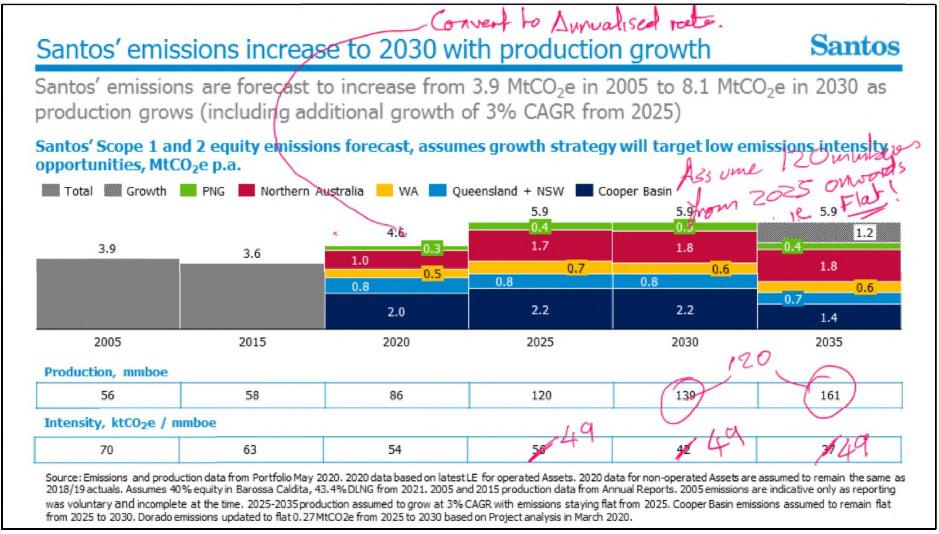
ACCR alleged that Santos had no reasonable grounds for assuming that both its emissions and gas production would remain flat out to 2035. Evidence showed Santos’ internal teams were forecasting increases in both metrics and the ‘flatline’ scenario that Santos ultimately published was purely based on the request from Gallagher. Internal correspondence showed that at least one analyst thought there was ‘effectively no basis’ for the flatline forecast.
However, the Federal Court ruled that this did not mean the revised presentation was misleading or deceptive. Accepting Santos’ arguments, the court concluded that it is within the remit of CEOs and other senior executives to amend the findings of their own analysts. Stating at [643]:
‘Strategic decisions about production and emissions were made by the CEO and senior executives and not by more junior employees ... Unsurprisingly, intervening strategic decisions may need to be made after preparation of the data. That is what occurred in 2020 with the development of the Targets and the Net Zero Roadmap.’
What does this mean for corporate accountability?
On the surface, the case was a victory for Santos. Companies have significant flexibility when outlining their net zero targets and climate transition plans. Companies can consider the inherent uncertainty and evolving nature of future policies, markets and technologies as factoring into what constitutes ‘reasonable grounds’ for those plans.
However, what the judgment really highlights is the extent to which ‘the law’ is a blunt tool for holding companies accountable for climate harms and delivering climate justice.
This is not a new understanding. Prior Australian climate cases have highlighted the extent to which the current law fails to adequately grapple with the evolving, complex and unique challenge of climate change. Climate litigation only emerged as a distinct area of legal practice within the last two decades.
Part of the reason for this is that the fossil fuel industry actively works to prevent the emergence of new climate law. The fossil fuel industry knows it is on the wrong side of climate justice. It is in its (short-term) financial interest to maintain the legal status quo.
It is why it attacks groups like ACCR and the lawyers that represent them. It is why companies like Santos target environmental law firms with SLAPP tactics.
Did ACCR succeed in its greenwashing claim against Santos? No.
But the judgment reinforced factual findings that the use of fossil gas is a contributor to global emissions and worsening global warming. Santos’ representations might not be misleading, but that does not mean the company’s actions are an adequate response to the climate crisis that we face, and to which it is a major contributor.
The law will continue to evolve and the pressure on fossil fuel companies will continue to grow.